
I. THE JOB NOBODY APPLIES FOR
One of the most radical statements in the Bible is not a battle cry. It is a resignation: He must increase. I must decrease.
A man said it as his platform was dissolving, and he called the feeling joy.
You were raised to be the main character. Build the brand. Grow the following. Curate the image. Turn your life into content, your name into an asset, your attention into revenue. That is the operating system this century sells — and it collects a commission on every hour. The result is a generation that has never been more seen and has never felt more alone.
Then the Book (the Bible) holds the most countercultural job description ever written: a man whose entire assignment is to make Someone else famous and get himself out of the frame.
The man was John, son of Zechariah — and Jesus called him the greatest born of women. Asked to define himself, he reached into Israel's own wedding tradition and named an office: the shoshbin, the friend of the bridegroom. In the ancient custom — a Jewish office first; the Church has only ever inherited it from the root — the friend carried the unseen half of a wedding. He made the match ready. He prepared the bride. He guarded the meeting of groom and bride. And his whole wages were one sound: the voice of the groom arriving.
When that voice came, John said the sentence that ought to be carved over every stage, studio, and stream in the modern world:
He must increase. I must decrease.
That sentence costs a person raised on personal branding everything. His crowds left. His moment emptied. His own men came to him with the numbers, straight from the Book: “Rabbi, the one you pointed to — everyone is going to Him now” (John 3:26). And John called it joy. Complete joy. Because the whole job was the Groom meeting the Bride — and a friend who watched it happen has lost nothing.
The friend of the Bridegroom is the original anti-influencer: real influence, spent on someone else's campaign. No analytics. No merch table. No career arc after the wedding.
And the job has never been discontinued. It is still open.

II. THE OFFICE, NOT A VIBE
Be clear about what this post is, because it is older than the Church and larger than a hashtag.
The friend stands. The first verb — the groom's friend, who stands by and listens for him. While the world sleeps, while the bride waits, he stands where he can hear the road.
The friend listens. Trained on one frequency in an age of six hundred channels. He hears a voice the rest of the house has stopped expecting.
The friend rejoices — at a sound. His entire paycheck cashed in one moment: the Groom is here.
And then the friend steps out of the light. That is not modesty. Modesty still wants to be noticed for not wanting notice. The friend is free — so free of the mirror that there is no mirror in the room at all. The Bride arrives; the Groom has the frame; the one who set the whole thing up exits the shot.
John took that ancient office and aimed it at the end of history — the wedding of God and His Bride. The friend of the Bridegroom is not a character you read about in first-century Palestine. It is a standing post — filled at the beginning, whispered of again at the end, and never empty in between. In every generation, ordinary people hold it: unbranded, uncounted, fully known to God.
Which means it might be yours.
III. THE MOMENT THIS OFFICE WAS MADE FOR
Every age gets its own machine. Ours comes personalized.
Book One names the machine and calls it what it is — Pharaoh's kingdom, still humming: you are what you produce. You are what you consume. You are what the crowd thinks of you. More bricks. Less straw. We are the first generation with a feed engineered to make us feel watched, behind, and insufficient several times an hour. More noise has never meant more of God.
And the most honest diagnosis in the Book is the one we least want:
God is not hard to hear. We are loud.
Nobody forces the bricks anymore. We volunteer — because busy feels like worth, because the scroll feels like company, because numb beats the quiet. Anyone can make noise for God. It takes a deeper courage to be quiet before Him — and stay.
The friend of the Bridegroom is what remains when a person walks out of the machine and repossesses the scarcest asset on earth: their attention — not hoarded as self-care, but spent as worship.
So be precise about the phrase this writing stands on: All in.
All in is not loud. Hype is loud for a weekend. All in shows up on a gray Tuesday, nobody watching, year after year. The friend has no exit plan, no side hustle for the soul, no backup bridegroom in the drawer. The venture called Me is shut down, and the proceeds go to His wedding.
And let no one call it soft. The job description contains a death — your own: "If anyone wants to follow after me, let him deny himself, take up his cross, and follow me" (Matthew 16:24). For the friend, this is a funeral for the need to be impressive. That is what I must decrease means. It is the one thing the curated self cannot fake. You can fake a great many ministries. You cannot fake a decrease nobody applauds.
There is fire in this office — it just doesn't perform. And there is a holiness in it: the warm kind that comes from standing too close to the flame for too long. Nearness. Reverence. Rest.
IV. JESUS — WHO THE BRIDEGROOM IS
All of this would be a beautiful fantasy and a bad career. No one liquidates a life for a sound. You go all in because of whose voice it is.
So name Him — for the near and for the far, for Israel and for the Church — one and the same answer: Yeshua of Nazareth — the Messiah of Israel, the Redeemer of the human race.
The witness is the Tanakh, the Scriptures of Israel (what the Church calls the Old Testament) — theirs long before the Church was born on Shavuot (Pentecost), and never withdrawn from them. God carved a promise through one family for the sake of every family. For centuries, guardians kept the flame. And in first-century Judea, thousands of the most Scripture-literate people who have ever lived looked at a Galilean carpenter and recognized their own scrolls — alive, and walking right toward them.
They knew His timing. Daniel's prophetic clock was ticking toward an Anointed One who would come and be cut off before the city and the sanctuary fell — and the clock was running out.
They knew His shape. Not a conqueror on a warhorse, but the humble King of Zechariah, riding a donkey. Not an empire, but Isaiah's Suffering Servant: pierced for our transgressions, crushed for our iniquities — the punishment that brought us peace was upon Him, and by His wounds we are healed.
They knew His authority. Healing the blind, cleansing lepers, teaching with an authority the scribes could only quote against — the Prophet like Moses promised in Deuteronomy 18.
And they knew His sequel. The execution at a feast, and then the empty tomb in broad daylight, in the very city where it happened. Guards posted, body gone, all unable to produce it. The resurrection is God's signature on the whole check.
But a hero for one nation was never big enough for the God of every nation. This same Messiah is the door the Church had been feeling toward in the dark: "Peace, peace, to him who is far off and to him who is near" (Isaiah 57:19). In Him the ancient hostility was put to death and the wall came down — not by erasing who anyone is, but by building one new man out of the two, in His own body (Ephesians 2:14–15). Israel was not replaced. The Church was grafted in — and lives by the root's sap (Romans 11:18). Salvation is from the Jews (John 4:22) — and the offer has no border. The promise walked out of Judah and has never stopped walking.
Here is the part that breaks the performance machine in half: He did the work. He carried the record of everything wrong — everything hidden, everything cruel, every betrayal, yours included — onto a Roman cross and died under it in your place, the Lamb Israel's prophets announced. And He came out of the grave, which is how you know the debt actually stayed buried. It is finished means finished.
Look at the paradoxes and let them undo you. He mapped the stars — and got tired at a well. He rode a borrowed donkey — and owns everything. The Lion of Judah arrived as the Lamb. The Judge arrived as the defense. The Groom paid for the wedding with His own blood.
And that is exactly why people go all in. Not because He demands it — but because they meet a Person who is supreme, sufficient, and utterly beautiful, and a half-life of half-devotion is no longer on the table. You don't have to perform to be loved by Him. He performed — perfectly, publicly, forever. You get to respond.
This is who the Friend spends his life making famous. Not a brand, not a movement, not a mood. A Person. He whispered for two thousand years; He will not whisper forever. A Shout is coming — and every quiet hour a friend keeps is rehearsal for it.
No one knows the day or the hour — the Groom Himself said so (Matthew 24:36). So the friend keeps watch, not a calendar: the posture is the assignment; the date is not.
V. THE SIX QUIET REBELLIONS
So how does a person train for an office this heavy — with no barracks, no uniform, no oath to sign?
You train with attention, not force. The real theft of our lifetime is not territory. It is your time and your gaze. The machine has never had a strategy beyond Pharaoh's: heavier work, so there is nothing left over for God. The friend meets it the old way — on his knees, in the secret place, with stillness, the Word, obedience, and intercession by name. His post is unseen. His orders come quietly — and the hardest ones come from a Groom who speaks softly.
Six rebellions, then — small enough to begin before midnight tonight. You will know them by their fruit, not their size.
1. The Five Minutes. Daily, sit with God and produce nothing. No notes. No output. No streak to screenshot. Breathe in: Abba. Breathe out: I belong to You. When the mind bolts — it will — bring it back. That returning is the whole skill. If five minutes of stillness feels impossible, ask who profits from that impossibility. Then rebel.
2. The Open Hands. Choose the mountain you're white-knuckling — the fear, the plan, the person you keep fixing. Sit. Open your hands on your knees. Say it plainly: This is Yours. I am done pushing. Leave it there. It will crawl back into your lap by morning; set it down again. Mountains don't fall from shoving. They melt in His presence.
3. The Hidden Act. One kindness a day that cannot be traced to you. No post. No hint. No mention at dinner. Do the good thing, delete the draft, tell no one. It will starve your ego for a week and feed your soul for a month. Old Jerusalem once built a room for exactly this — the Chamber of the Silent, where the devout gave in secret and the poor received in secret, and neither ever saw the other's face.
4. The Turned Heart. One hard turn toward the face in front of you: the apology that goes first, the call to the parent, the phone facedown at the table. The world will never read your prayer journal. It will read you. The holiest thing some of you will do this year is forgive your father, or call your son.
5. The Hour. One hour a week — growing toward a whole day — of Sabbath. No feed. No buy. No agenda. Not a day off. A palace built of time — the weekly rehearsal of the wholeness the King is returning with. The machine has nothing that competes with this one, which is why it will mock you most for it.
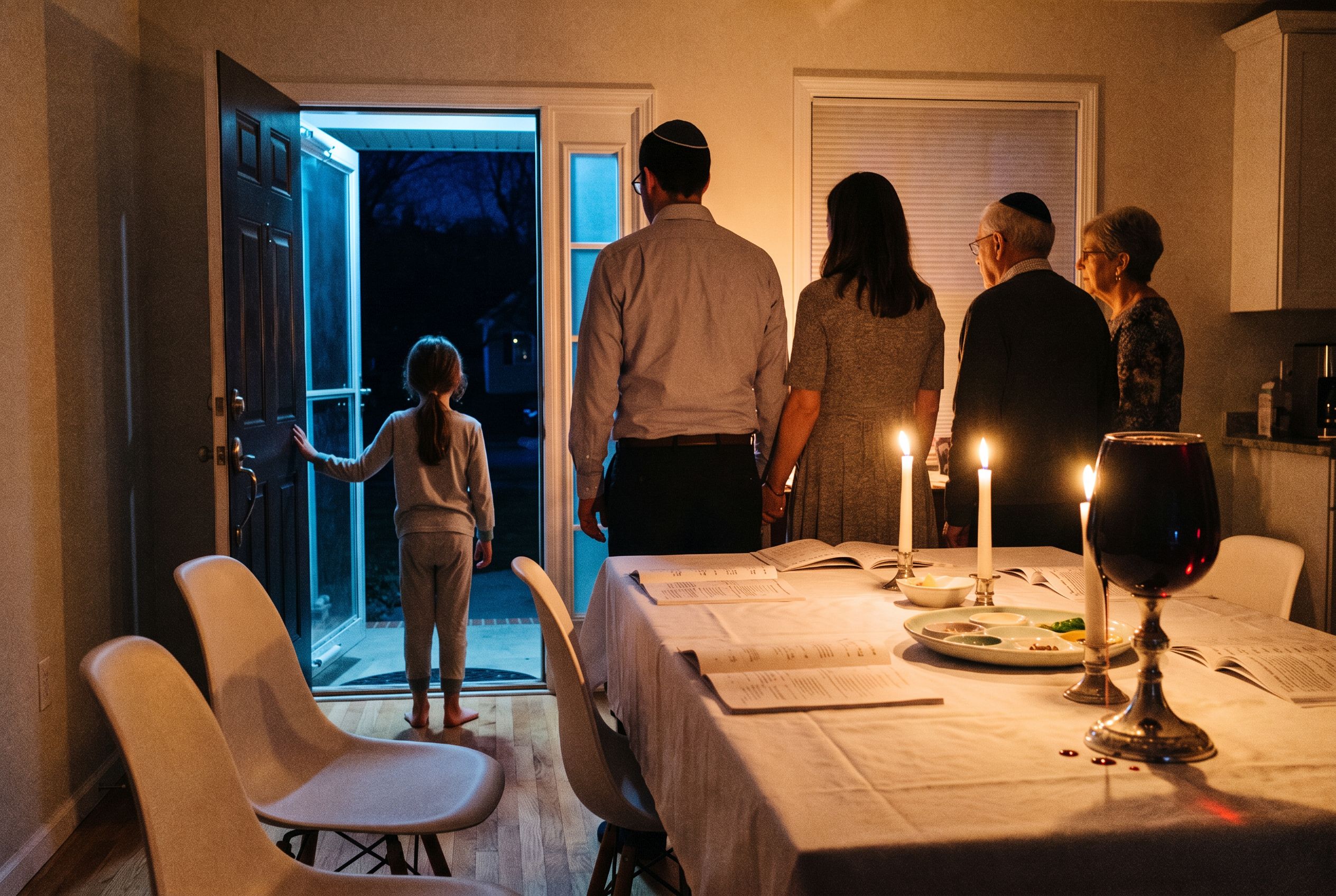
6. The Two Words. End every day the way the earliest believers ended everything: Maranatha — Come, Lord Jesus. Say it the way a bride watches the road. Say it the way a friend, standing by the door, listens through the dark for footsteps.
Mark the filter now, because it will save you later: not one of these six will make you impressive. That is the design. The doors are small on purpose — small is how they get missed — and they all open to hearing one Voice through the noise, and wanting no other.
And if you miss a day, the Voice does not change. These are doors, not duties — welcome first, then the change, in that order. Nobody earns the wedding; the invitation was written in blood.

VI. THE DOOR IS OPEN
The office is not gated, not branded, not sold. It is received — never bought. You do not need the name; most who hold the post never take it. Formed in private over years, never streamed. The only credential is the Groom Himself. The only disqualification is wanting the applause more than the Voice.
And the door is wide — wide enough for both sides of the ancient map. If Shabbat and the Shema are your inheritance, kept at a thousand Friday tables before you were born: this door is yours. The well was dug in your family's ground — and it was dug for a Voice. You have already read His name. If you heard the name Jesus only last Tuesday and are not sure you belong inside any of this: same door, same Voice, same road. You are not too late, too dirty, too secular, or too anything. The first friends were a priest's son and fishermen with dirt under their fingernails.
And you will not hold the post alone. There is a hidden number — the Book keeps saying it: seven thousand who never bowed (1 Kings 19:18). … God keeps the list. You don't join it; you belong to Him.
All in for Jesus. Unseen on purpose. His alone.
He must increase. I must decrease.
Maranatha. Come, Lord Jesus.